

when the chess robot burned, a witness heard it say check
Philadelphia, the night of July 5, 1854, a little after half past ten. A fire started at the National Theatre on Chestnut Street and walked east through the Girard House and into the Chinese Museum. On a back staircase at the museum's eastern end, closest to the flames, stood a wooden cabinet with a carved man in a turban seated behind it. A young doctor named Silas Weir Mitchell ran into the lower hall and got as far as the foot of that staircase. Smoke had taken the landing. He stood there and, as he wrote three years later in the Chess Monthly, heard through the roar a whispered, repeated "Échec! Échec!" In the same paragraph he admits it may have been timber cracking or glass going.
The machine was eighty-four years old. In 1770 Wolfgang von Kempelen had rolled it into the court of Empress Maria Theresa in Vienna, and the show never changed. He opened the cabinet doors one at a time and held a candle to the gears so the room could see straight through. Clockwork, nothing else. He shut the doors, wound a key, and the figure reached out its left arm and moved a pawn.
What the candle never lit was a sliding seat. While one door stood open, a man inside slid to the other side of the cabinet, and dummy machinery slid into the space he had left. When the doors closed he sat in the dark with a small board of his own, followed the game through magnets under the squares, and worked the arm with a pantograph. Kempelen's door ritual was the real invention. The chess was just chess.
It toured for decades. In Paris in 1783 its final game was against Benjamin Franklin, then the American ambassador, who lost and stayed curious about the thing for the rest of his life. In 1809 at Schönbrunn, Napoleon reportedly tried illegal moves. In the version historians find most likely, the Turk put the piece back, then swept the board clear, and Napoleon sat down and lost a proper game in nineteen moves. Mitchell himself flagged the Napoleon stories as probably invented, so take the sweep with salt. In April 1836 Edgar Allan Poe, who had watched it play in Richmond, published an essay in the Southern Literary Messenger arguing that a person was inside. He pointed at the fixed order of the door routine and at the fact that the figure played left-handed, which is what you'd get if a right-handed man were reaching across.
The operators were real masters, paid to vanish. Johann Allgaier played it in Vienna and Jacques Mouret on the 1819 British tour, and in America the job went to William Schlumberger, a man upwards of six feet tall, folded nightly into a box about the size of a writing desk. In Baltimore in 1827 two boys on a roof watched him climb out after a show, and the secret leaked for the first time. He died of yellow fever in Havana in February 1838 with the cabinet in the next room. Maelzel, the showman who had bought the Turk and run it for thirty years, died at sea that July on the way home, in debt, with the machinery left to the ship's captain. He was the ghostwriter in the machine, and nobody wrote down what the work was like.
In 2005 Amazon launched a marketplace for tiny human tasks and named it after the hoax. Jeff Bezos called it "artificial artificial intelligence." The job was to be the man in the box for pennies: tag this photo, or say whether this sentence sounds angry. Between 2008 and 2010, about 49,000 Mechanical Turk workers in 167 countries sorted the fourteen million photographs of ImageNet, the dataset that taught computers to see. Amazon's own documentation would later count more than 500,000 workers across 190 countries.
Amazon closed the platform to new customers on July 30, 2026. The last tasks could be submitted on September 30. The people hidden inside the machine had labeled the thing that replaced the machine, and the notice announcing the end mentioned a periodic review of programs.
You know the door ritual. The caption says you woke up like this. The reply says lol no worries. The post that reads like it was dashed off went through four drafts and a friend on FaceTime saying it's good. Somebody opened a door, held up a candle, and showed you the gears, and you looked at the turban because the turban is where you're supposed to look.
Kempelen understood that an audience checks the inside once. After that they watch the arm.
Eighty-four years and nobody asked the guy inside how he was.
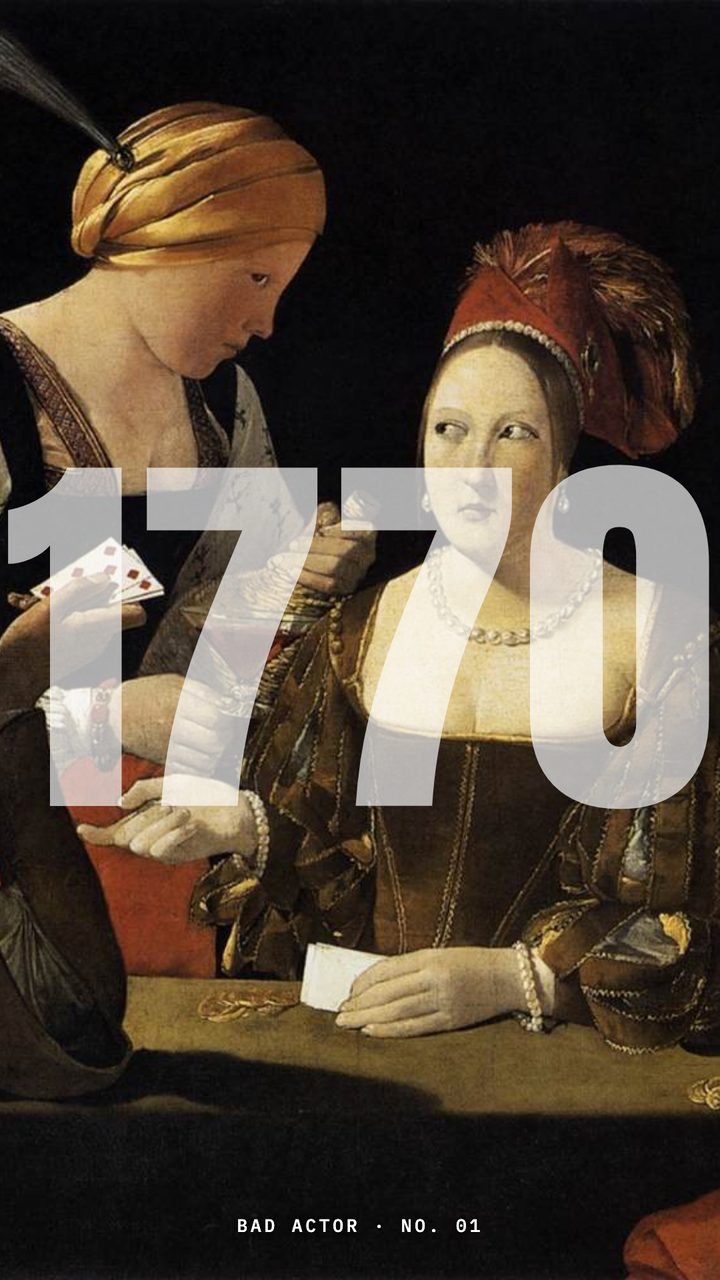
The painting: Georges de La Tour, The Cheat with the Ace of Diamonds (c. 1635), Louvre. Public domain.
Sources
- Kempelen, Maria Theresa, the candle, the sliding seat, Franklin 1783, the 1854 fire
- Mitchell's "Échec! Échec!" and his doubts; Schlumberger's height; the pantograph
- Operators, the Baltimore rooftop, Schlumberger's death, Maelzel's death at sea, Napoleon at Schönbrunn
- Poe, "Maelzel's Chess-Player," Southern Literary Messenger, April 1836
- Mechanical Turk launched 2005; "artificial artificial intelligence"
- ImageNet labeled by about 49,000 workers in 167 countries
- Shutdown on September 30, 2026; 500,000 workers in 190 countries