

he'd already lost the match, then he came back
Sunday, March 13, 2016. The scoreboard at the Four Seasons in Seoul reads AlphaGo 3, Lee Sedol 0. The match was decided the afternoon before, when Lee resigned game three; the million-dollar prize is already on its way to UNICEF and a few Go associations, because Google had said from the start that a winning program would not keep it. Two games are left on the schedule and there is no reason to play them except that they are on the schedule.
Lee shows up. He takes white.
Through the middle of the game it looks like the first three. AlphaGo has built a large framework in the center and Lee's stones inside it are short of life. The commentators are talking about when rather than whether. Then, at move 78, Lee pushes a white stone into the middle of the black position, a wedge between two black stones that does not connect to anything yet and cannot be captured cleanly either. Go has a word for a clever local move, tesuji, and nobody in either commentary room had read this one.
Demis Hassabis said afterward that AlphaGo had put the probability of that move at about one in ten thousand. The same number, from the same program, that it had put on its own move 37 three days earlier. One for each side of the board.
The machine answered on 79, and the answer was wrong. Its value network, the part that guesses who is winning, still read the position at around 70 percent for black. It stayed there for a while. Then, around move 87, the number fell off a cliff, and for the next dozen or so moves AlphaGo played like something that had just noticed the building was on fire: threats that did not threaten, stones in places a teacher would tell a beginner to avoid. People in the room said it looked like panic. Hassabis, careful about words, said the program had "thought" it was winning until 87, then clarified that by thought he meant the output of a network. At move 180 the estimate dropped under 20 percent, the line at which AlphaGo is programmed to resign, and it did.
Gu Li, one of the strongest players in China, was commentating in Chinese and called 78 a divine move. The phrase that stuck in the Korean coverage was "God's touch." Lee, at the press conference, called it a priceless win he would not exchange for anything, and then, as the questions kept coming, said he had never in his life been congratulated this much for winning a single game.
He lost game five. The match ended 4-1. He never beat AlphaGo again and nobody else beat it at all. In official play, game four is the only game the program ever lost to a person. (Fan Hui took a few informal fast games off an earlier version in 2015, before the last five months of training. Lee's is the one in the record.)
divine
Here is my trouble with the word. A god does not have to come back on Sunday after losing Thursday, Friday and Saturday. A god has not spent the weekend reading Korean papers call it the end of something. What played 78 was a tired man who had already lost, sitting down anyway and putting a stone where, by his opponent's own accounting, one player in ten thousand would.
i'm only human baby, please don't think of me as divine
In November 2019 Lee retired from professional Go. Even if he became number one, he said, there was an entity that could not be defeated, and he would rather stop. In May 2021 the record of game four went up for auction on OpenSea as an NFT, and somebody bought the file for 60 ether, about $210,000 that week.
What he kept was never for sale: one game that nobody else has, out of five he was never supposed to play.
You are three games down at something. Everyone can see the score. Game four is still on the calendar.
The move has a name now. What it was, on the day, was a man who had lost, and came back anyway, and sat down.
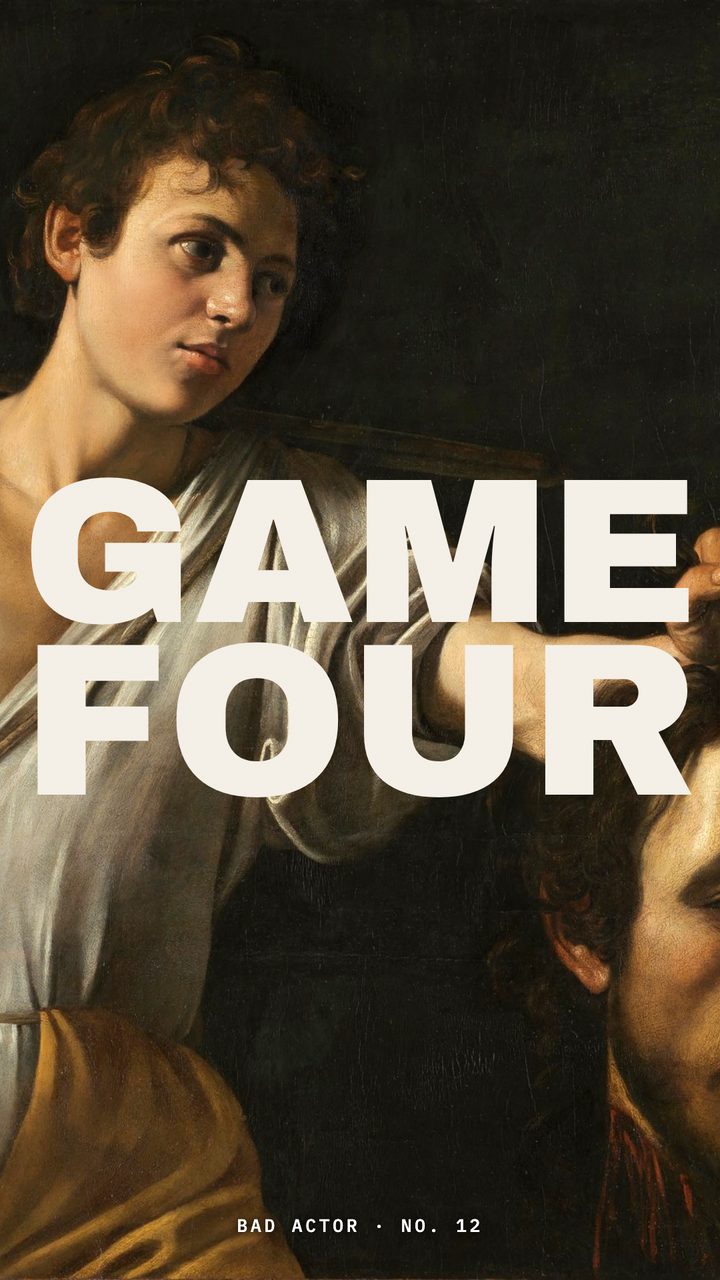
The painting: Caravaggio, David with the Head of Goliath (c. 1607), Kunsthistorisches Museum, Vienna. Public domain.
Sources
- Game 4, March 13, 2016; Lee white; move 78 the wedge; Gu Li's "divine move"; AlphaGo's ~70 percent at 79, collapse at 87, weak moves 87 to 101, resignation under 20 percent at move 180; "priceless win"; prize to charity; match 4-1
- Hassabis: one in ten thousand; Go players' "God's touch"
- Hassabis on the mistake at 79, the realization at 87, and what "thought" means
- Lee: never congratulated so much for winning one game
- Fan Hui's informal fast games against the 2015 version
- Retirement, November 19, 2019: "an entity that cannot be defeated"
- Game 4 sold as an NFT on OpenSea for 60 ETH, about $210,000, May 2021